Google released Gemini 4 Neon on November 18, 2026. It is an AI model designed for complex software engineering, knowledge work, and scientific research. Unlike AI models primarily used for everyday questions and answers, Gemini 4 Neon can understand complex instructions, use tools, coordinate multiple AI agents, and carry out multi-step tasks over extended periods, helping users turn complex requirements into practical results.
From software development and data analysis to multimodal information processing and automated workflows, Gemini 4 Neon represents a shift from single-turn AI conversations toward continuous task execution.
Core Capabilities of Gemini 4 Neon
Gemini 4 Neon focuses on three main areas: advanced reasoning, AI agent execution, and multimodal information processing.
Advanced Reasoning and Multi-Step Tasks
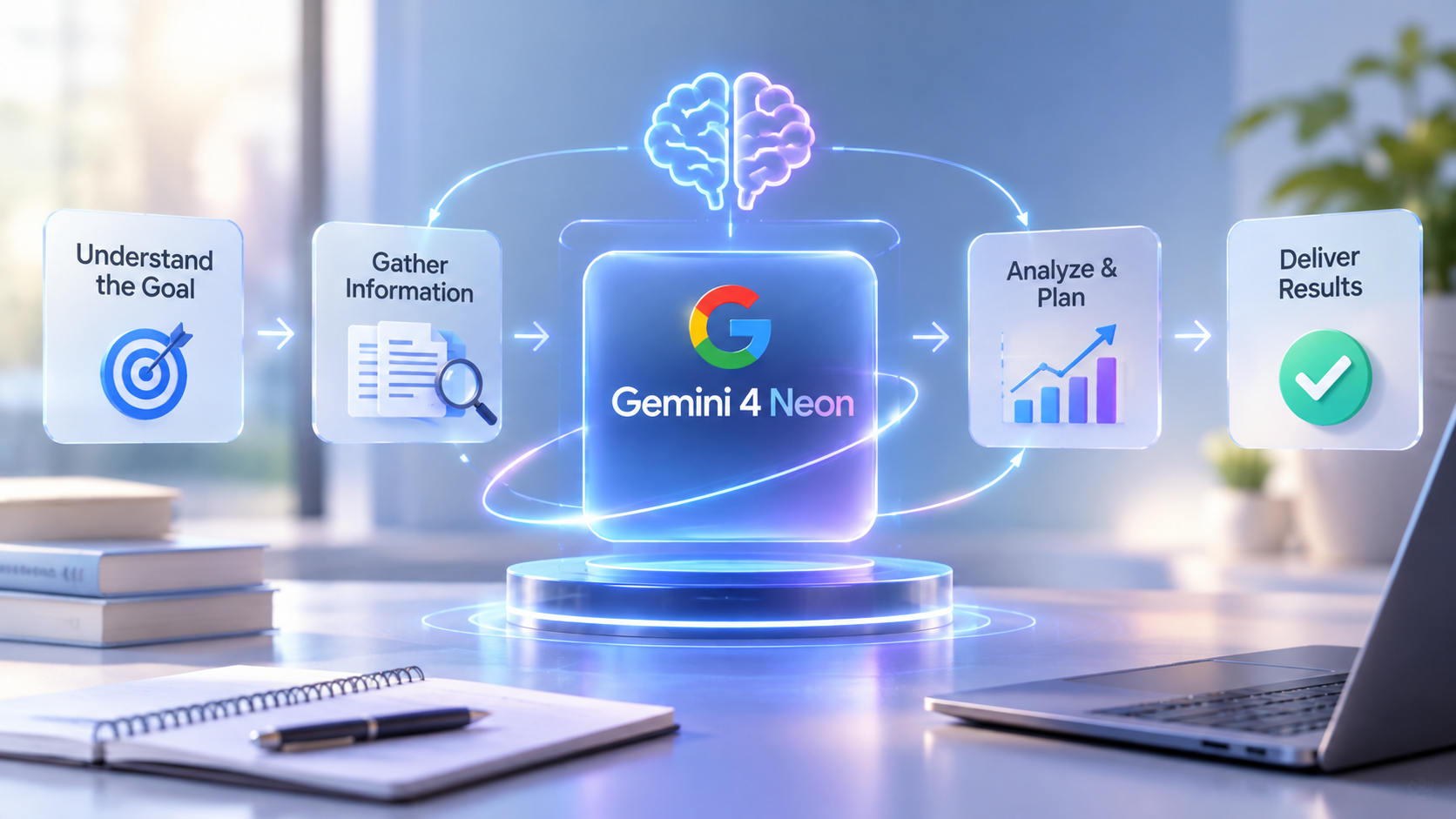
Complex problems often require more than a single answer. AI needs to gather relevant information, analyze different conditions, and develop a practical plan before reaching a result.
Gemini 4 Neon is designed to handle these multi-step reasoning tasks. For example, it can analyze reports containing large amounts of data, compare information across multiple files, or organize research findings from different sources.
It can first understand the overall goal, then work through the individual steps, organize relevant information, and adjust its approach based on the results. Instead of breaking a complex task into dozens of separate instructions, users can simply describe what they want to achieve and let the model help move the process forward.
Long-Running AI Agent Workflows
An AI agent is an AI assistant that can independently carry out tasks based on a defined goal. Rather than simply answering questions, it can use tools, read files, perform actions, and decide what to do next based on the results.
Gemini 4 Neon is optimized for long-running AI agent workflows. It can track task progress, reduce repetitive file reading, and act as an orchestrator in Google Antigravity, coordinating multiple Gemini 4 Hydrogen sub-agents to handle different parts of a task.
For example, a large software development project can be divided into several stages. One agent can analyze the codebase, another can develop new features, and others can review the code and run tests, while Neon coordinates the overall workflow.
Multimodal Information Processing
Gemini 4 Neon goes beyond text processing. It also supports image, audio, and video inputs. According to Google DeepMind's published model specifications, its unified input and output context capacity can reach up to 1 million tokens.
This allows the model to work with large amounts of information in different formats within the same task. For example, users can provide PDF documents, spreadsheets, charts, and videos for Gemini 4 Neon to analyze together, without having to explain the contents of each file individually.
This multimodal capability is particularly useful for research, office work, and content creation involving large amounts of reference material. The available context capacity and features may vary depending on the platform.
Coding and Real-World Applications
Software development is one of the key application areas for Gemini 4 Neon. Beyond generating code, it can analyze existing codebases, identify errors, modify multiple files, and work through larger software development tasks step by step.
Google's demonstrations highlight how the model can handle complex projects:
3D Simulator Development: Gemini 4 Neon built a WebGL2-based freestyle skiing simulator from scratch, using real terrain data from Mont Blanc and Chamonix. The project included approximately 10,200 lines of custom shaders and 120 Hz skiing physics simulation.
Complex Spreadsheet Generation: In Google Antigravity, multiple Neon agents used a single image to create a Google Sheet containing 100,000 cells and more than 500,000 live formulas. The spreadsheet handled image edge detection, 3D depth mapping, and lighting effects.
Interactive 3D Scene Reconstruction: Through multi-agent collaboration, Gemini 4 Neon used archival photographs to reconstruct Alan Turing's 1936 study at King's College, Cambridge, and turned it into an interactive 3D environment.
These examples show that Gemini 4 Neon is not limited to generating text or code. It can also understand project requirements, use different tools, and connect multiple steps to deliver more complex results.
Gemini 4 Neon Benchmark Performance
In addition to real-world demonstrations, benchmark results provide another way to understand Gemini 4 Neon's capabilities.
According to Google DeepMind's November 2026 evaluation results, Gemini 4 Neon performs across several areas, including coding, knowledge work, scientific reasoning, and long-context processing.
Benchmark | Gemini 4 Neon Score |
|---|---|
Artificial Analysis Intelligence Index (v5.0.1) | 61 |
Vals Index (v2.2) | 70.9% |
CursorBench 4.1 | 65.4% |
Terminal-Bench 4.1 | 65.2% |
SWE-sweep (Provider Harness) | 39.0% |
AutomationBench | 56.3% |
RiemannBench | 84.0% |
HLE-Diamond | 71.3% |
GraphWalks (256K–1M) | 95.2% |
These benchmarks measure different aspects of model performance. For example, CursorBench, Terminal-Bench, and SWE-sweep focus mainly on coding and agent execution. AutomationBench evaluates automated task performance, while RiemannBench focuses on scientific and mathematical reasoning and HLE-Diamond measures the ability to solve complex problems. GraphWalks evaluates how well the model handles long-context information.
It is important to note that different benchmarks use different scoring methods and testing conditions. A single score should not be used to judge a model's overall capabilities.
Where Gemini 4 Neon Fits in the Gemini 4 Family
Gemini 4 Neon is an adapted version of Gemini 4 Carbon, designed primarily for tasks that require sustained analysis and execution. Each model in the Gemini 4 family has a different focus:
Gemini 4 Carbon: Better suited to highly challenging tasks that require extended processing.
Gemini 4 Neon: Focuses on coding, analytical reasoning, and enterprise workflows, making it suitable for tasks involving multiple execution steps.
Gemini 4 Hydrogen: Better suited to handling everyday tasks quickly and can also serve as a sub-agent coordinated by Neon.
In simple terms, Carbon focuses on demanding tasks, Neon manages complex workflows, and Hydrogen handles smaller, more clearly defined tasks.
This division allows the Gemini 4 family to support different workloads by using the model best suited to each task.
How to Access Gemini 4 Neon
According to Google's published information, Gemini 4 Neon is available through several channels:
Gemini App: Eligible Google AI Pro and Ultra subscribers can access the model through the model selection menu.
Google AI Studio and Gemini API: Developers can try the model through these platforms and integrate it into their own applications.
Android Studio: Developers can use Gemini 4 Neon in Android development workflows through the Gemini API.
Google Antigravity: Suitable for complex coding tasks and multi-agent collaboration workflows.
Gemini for Business: Enterprise users can access the model through API integrations or the model selection menu.
Availability may vary depending on the subscription plan and region.
Frequently Asked Questions
What Tasks Is Gemini 4 Neon Best Suited For?
Gemini 4 Neon is designed for complex coding, code analysis, data processing, scientific research, multimodal information analysis, and AI agent workflows that involve multiple steps. It is particularly useful for tasks that require continuous tool use, processing large amounts of information, and completing several stages of work.
Does Gemini 4 Neon Support Image and Video Inputs?
Yes. Gemini 4 Neon can process text, images, audio, and video, allowing it to combine different types of information for analysis. Its context capacity can reach up to 1 million tokens, making it suitable for working with large amounts of reference material.
How Is Gemini 4 Neon Different from Other Gemini 4 Models?
Different models in the Gemini 4 family are designed for different types of tasks. Carbon is better suited to highly challenging tasks that require longer execution times. Neon focuses on coding, analytical reasoning, and multi-step agent workflows. Hydrogen is designed for handling everyday tasks quickly and can also serve as a sub-agent coordinated by Neon.
Can Gemini 4 Neon Be Used for AI Agent Development?
Yes. Gemini 4 Neon supports tool use and long-running task execution. It can also coordinate multiple Hydrogen sub-agents in Google Antigravity. Developers can use these capabilities to build AI agent applications that break down tasks, use tools, and coordinate different execution steps.
Conclusion
Gemini 4 Neon's main goal is not simply to make AI better at answering questions, but to enable it to take part in more practical work.
From writing and debugging code to analyzing large amounts of information and coordinating multiple AI agents, Gemini 4 Neon demonstrates how AI is moving beyond single-turn conversations toward continuous task execution.
For developers and enterprise users, it is particularly suited to complex workflows that require analysis, planning, tool use, and the delivery of practical results.