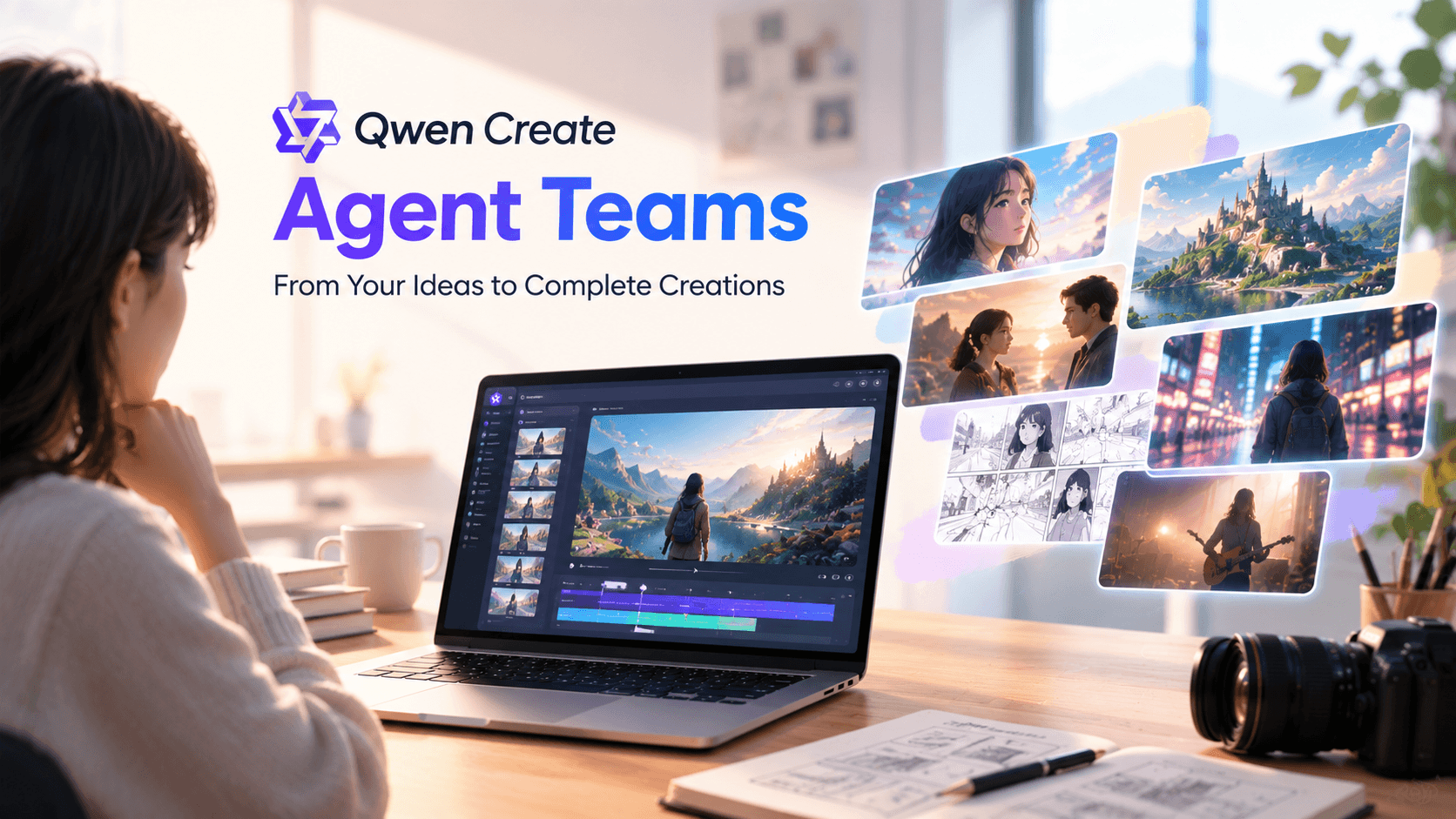
Qwen Create: How AI Agent Teams Are Changing Content Creation
AI creation is moving beyond simple prompt-based generation.
Instead of asking users to generate images, videos, scripts, and other assets one step at a time, a new generation of AI platforms is beginning to organize these tasks into complete creative workflows.
Qwen Create is one example of this shift.
On August 31, 2026, Qwen Create introduced Agent Teams, a multi-agent creation system designed to bring different creative roles into a single workflow. According to public reports, the system can coordinate AI roles such as screenwriter, director, art designer, cinematographer, and editor, helping users move from an initial idea toward a finished creative project. Qwen Create also integrates models including Wan 3.0 and Qwen-Image-3.0 to support video and visual generation.
Rather than functioning as another standalone AI video generator, Qwen Create is positioning itself as an AI-powered creative workspace where multiple agents and models work together.
What Is Qwen Create?
Qwen Create is an AI content creation platform from the Qwen team, designed to help users develop visual and narrative content through AI.
Its focus extends beyond individual image or video generation. The platform brings together creative planning, storytelling, visual development, video generation, and other production tasks within a unified workflow.
This makes it particularly relevant to projects such as:
· AI short dramas
· Dynamic comics and visual stories
· Marketing videos
· Music videos
· Character and scene design
· Story-driven visual content
The platform is built around a simple idea:
Users provide the creative direction, while AI handles more of the production process.
That distinction becomes more important with the introduction of Agent Teams.
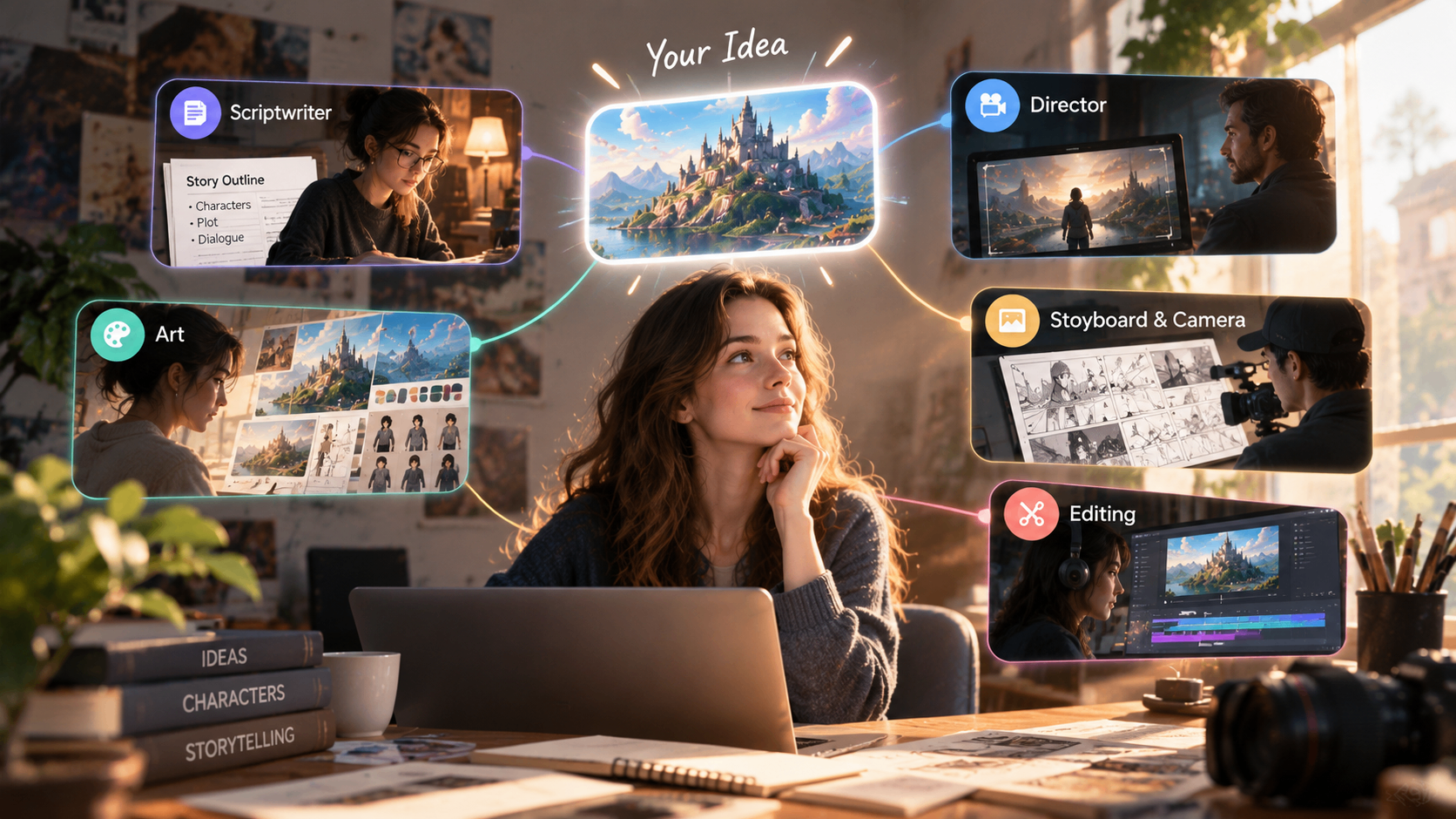
What Is Qwen Agent Teams?
Agent Teams is the core concept behind Qwen Create's new workflow.
Instead of relying on a single AI agent to handle every part of a project, the system can divide a larger creative task into different roles.
A simplified workflow looks like this:
Creative Idea → Planning → Script → Visual Design → Storyboard → Video Generation → Editing
Different agents can contribute at different stages.
Script Agent
The script-focused role can help turn an initial idea into a structured story, including characters, relationships, plot development, and dialogue.
Director Agent
The director role focuses on how the story should be presented visually, helping organize scenes, shots, pacing, and narrative progression.
Art Agent
The art-focused role can develop the visual direction of characters, environments, costumes, props, and other creative assets.
Storyboard and Cinematography Roles
These roles help translate the story into individual shots and determine how scenes should be presented from a visual perspective.
Editing Agent
At the final stage, AI can help organize generated material into a more coherent piece of content.
The important point is not simply that there are several AI roles.
It is that these roles can work together as part of the same creative process.
How Qwen Agent Teams Works
The workflow can be understood in four broad stages.
Start with an Idea
Users can begin with a relatively simple creative concept rather than a fully developed production brief.
For example:
Create a short film about a young woman searching for her missing father in a rainy city.
The initial idea becomes the starting point for the AI workflow.
AI Breaks the Idea into Tasks
Instead of asking the user to manually determine every production step, the Agent Team can break the concept into different creative requirements.
The system may need to determine:
· What is the story?
· Who are the characters?
· What locations are required?
· What visual style fits the story?
· How should the story be divided into scenes?
· What shots are needed?
· Which assets need to be generated?
This transforms an open-ended idea into a structured production process.
Different Agents Handle Different Roles
Once the tasks are defined, different AI roles can contribute to the project.
The script role develops the story.
The art role establishes the visual assets.
The director and storyboard roles organize the scenes.
Video models generate the footage.
The editing process then brings the material together.
Instead of repeatedly moving between unrelated tools, the user can work within a connected AI creation workflow.
The User Acts as Creative Director
The user does not disappear from the process.
Instead, the user's role changes.
Rather than writing every prompt and manually managing every generation step, the user can focus more on:
· Creative direction
· Story decisions
· Visual preferences
· Character choices
· Scene revisions
· Final approval
This creates a different relationship between the user and AI:
From Prompt Writer to Creative Director.
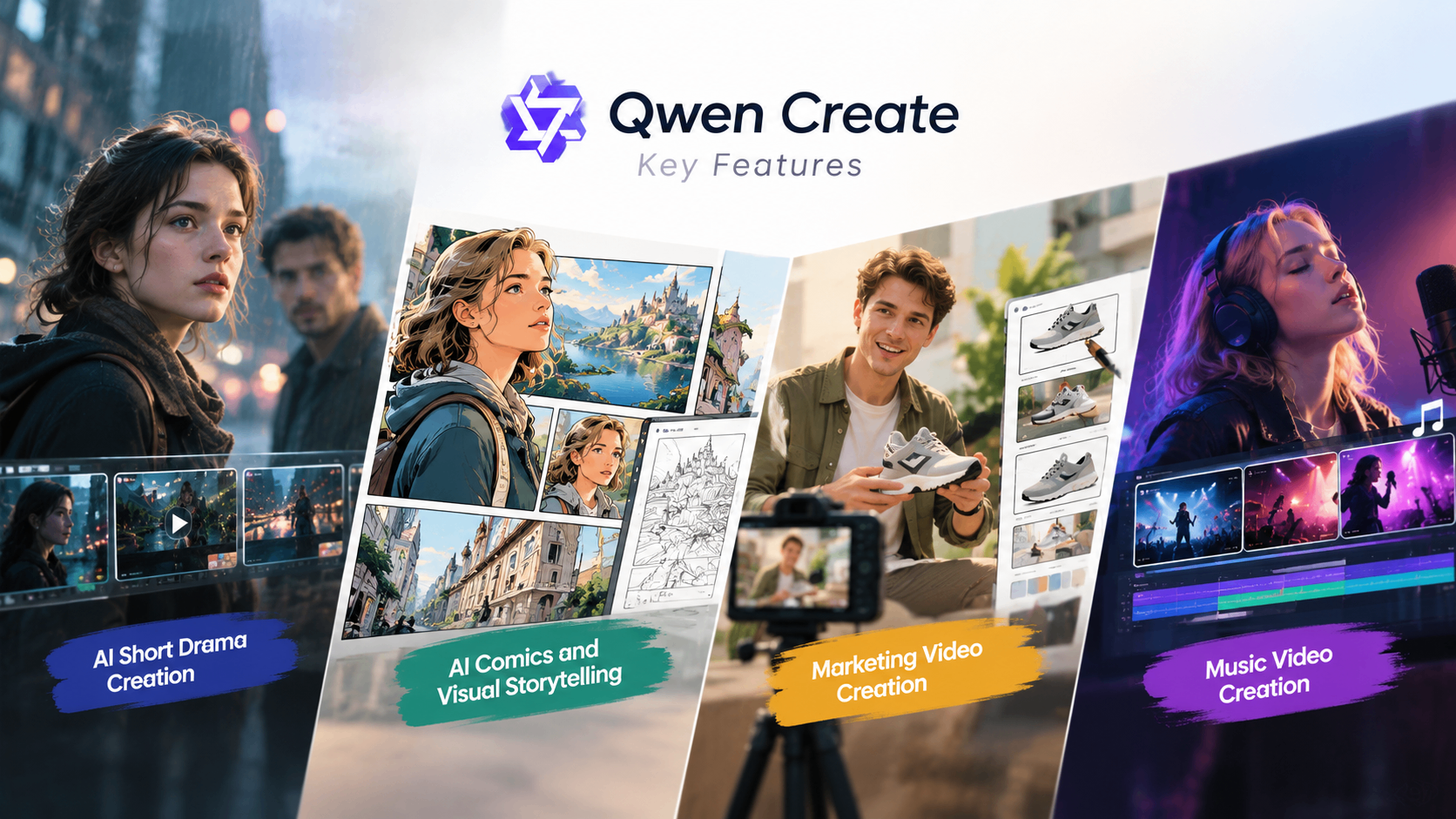
Key Features of Qwen Create
AI Short Drama Creation
AI short drama is one of the clearest applications for a multi-agent creative workflow.
A short drama requires much more than generating individual video clips. It involves story structure, characters, scenes, dialogue, camera shots, visual consistency, and editing.
With Agent Teams, these tasks can be organized into a connected process.
A creator can start with a story concept and gradually develop it into:
Story → Characters → Scenes → Storyboard → Video → Final Cut
This approach can reduce the amount of manual coordination required between different stages of production.
It is particularly useful for creators working on:
· Short narrative videos
· Serialized stories
· Character-driven content
· Social media dramas
· Experimental films
AI Comics and Visual Storytelling
The same workflow can be applied to comics and dynamic visual stories.
A visual story needs consistency across multiple images and scenes. Characters, environments, costumes, and narrative details need to remain connected as the story develops.
Instead of treating every image as an isolated generation task, an AI-assisted workflow can organize these elements around a common story.
This makes Agent Teams potentially useful for:
· Dynamic comics
· AI manhua
· Story illustrations
· Character-based series
· Visual novels and narrative concepts
Marketing Video Creation
Marketing content is another natural use case.
A conventional AI video generator may produce a short clip from a prompt. A marketing project, however, requires a broader set of decisions.
For example:
Product → Selling Point → Concept → Script → Visual Direction → Shots → Video
An AI creative team can help connect these steps.
A marketer could start with a product and campaign objective, then use AI to develop the concept, script, visual direction, and video assets.
This can make AI video creation more practical for advertising and social media campaigns.
Music Video Creation
Music videos also benefit from a workflow-based approach.
A successful MV needs visual ideas that match the music's mood, rhythm, story, and structure.
Agent Teams can help connect:
Music → Concept → Story → Visual Style → Scenes → Shots → Video
This gives creators a way to develop visuals around a complete creative concept rather than generating disconnected clips.
The Models Behind Qwen Create
Agent Teams provides the workflow layer, while generative models provide many of the underlying creative capabilities.
Qwen Create integrates models from the Qwen and Alibaba ecosystem, including Wan 3.0, Wan 3.0 Prime, and Qwen-Image-3.0.
Their roles can be understood broadly as:
Model | Role in the Creative Workflow |
Wan 3.0 | AI video generation |
Wan 3.0 Prime | Video creation and visual production |
Qwen-Image-3.0 | AI image and visual generation |
The significance of this model integration is that users do not necessarily need to think about every model as a separate product.
Instead, the models can function as components within a larger creative workflow.
This is an important distinction.
The model generates the asset. The Agent organizes the work.
Qwen Create vs. Traditional AI Creation Tools
The difference becomes clearer when comparing the two approaches.
Traditional AI Creation | Qwen Create |
Prompt-driven | Idea-driven |
Focuses on individual generations | Focuses on complete workflows |
Often uses one tool at a time | Coordinates multiple AI roles |
User manages most production steps | Agents can handle more coordination |
Generation is the main task | Creation workflow is the main focus |
Best suited to individual assets | Designed for larger creative projects |
This does not mean traditional AI generation tools are no longer useful.
If a creator simply wants to generate one image or one short video, a conventional generator may be faster.
The advantage of an Agent-based platform becomes more apparent when the task involves multiple connected production stages.
Who Is Qwen Create For?
Qwen Create can be useful for different types of users:
User | Potential Benefit |
Individual creators | Develop ideas without a full production team |
Video creators | Accelerate scripting, visual development, and production |
Storytellers | Turn concepts into structured visual stories |
Marketers | Create advertising and social content more efficiently |
Small teams | Use AI to support multiple creative roles |
For beginners, the main advantage is a lower barrier to complex creation.
For experienced creators, the value lies more in reducing repetitive production work and coordinating different stages of a project.
From Prompt Writer to Creative Director
The broader significance of Qwen Create lies in how it changes the role of the human creator.
Traditional AI creation often looks like this:
Human decides everything → AI generates
Agent-based creation moves closer to:
Human defines the goal → AI plans and executes → Human reviews and directs
This does not eliminate creative control.
Instead, it moves creative control to a higher level.
The user can spend less time thinking about individual prompts and more time thinking about:
What should the story be?
What should the character feel like?
What should the audience experience?
Which version is better?
This is why the transition from Prompt Writer to Creative Director may be one of the most important ideas behind Agent-based content creation.
What Qwen Create Means for AI Content Creation
The emergence of Agent Teams points to a broader change in the AI creation ecosystem.
AI models have already become capable of generating increasingly sophisticated images, videos, audio, and text.
The next challenge is no longer simply:
Can AI generate this?
It is:
Can AI organize everything required to create something complete?
That requires more than a powerful generation model.
It requires planning, task decomposition, role assignment, context management, asset coordination, and revision.
Qwen Create is attempting to bring these capabilities together in one creative environment.
Instead of treating AI models as isolated tools, the platform treats them as components of a larger production system.
Final Thoughts
Qwen Create represents a shift from AI generation to AI-assisted production.
Its Agent Teams approach brings different creative roles together and connects them with image and video generation models. For projects such as short dramas, comics, marketing videos, and music videos, this can provide a more structured way to move from an initial idea to a finished piece of content.
The most important change is not simply the addition of more AI models.
It is the shift from:
“Tell AI how to generate something.”
to:
“Tell AI what you want to create.”
As AI platforms continue to evolve, the ability to coordinate multiple models and specialized agents may become just as important as the quality of any individual generation model.
Qwen Create's Agent Teams is an early example of what that future could look like.