MiniMax H3: From AI Video Clips to Complete Audiovisual Scenes
AI video generation is gradually moving beyond simply creating short and visually impressive video clips. As models continue to improve in motion, longer sequences, and multimodal processing, the industry's focus is shifting toward generating more complete and cohesive scenes from the beginning.
MiniMax H3 is part of this transition.
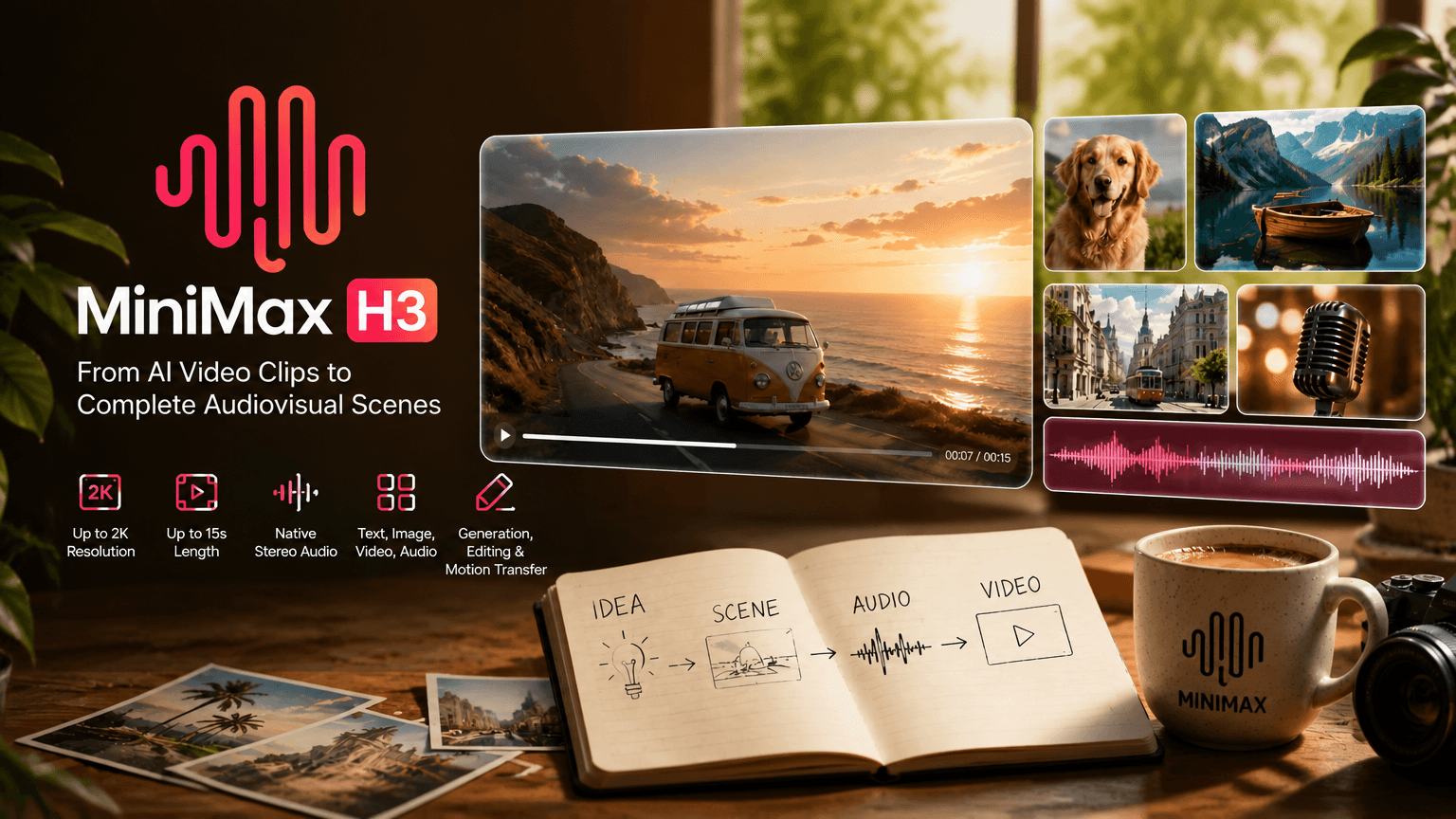
MiniMax officially launched H3 in July 2026 and subsequently open-sourced the model in August. H3 is a general-purpose multimodal generation model that can jointly understand text, images, video, and audio, and generate videos at up to 2K resolution, up to 15 seconds in length, with native stereo audio.
These capabilities are not isolated features. Together, they represent a different approach to AI video creation—one in which visual content, scene progression, reference materials, and sound can be developed within a more unified workflow.
For creators working on advertising, social media content, music visuals, and short-form storytelling, this approach can reduce the need to handle every production element as a separate step, creating a more connected path from an initial idea to a complete audiovisual scene.
MiniMax H3 at a Glance
MiniMax H3 has been officially released and is now available for practical use. MiniMax positions it as a general-purpose multimodal generation system rather than simply a traditional text-to-video model. H3 can process text, images, video, and audio within a unified context and generate video content based on these different types of input.
Category | MiniMax H3 |
Release Status | Officially released and open-sourced |
Maximum Output Resolution | Up to 2K |
Maximum Generation Length | Up to 15 seconds |
Audio | Native stereo audio |
Input Types | Text, images, video, and audio |
Core Direction | Multimodal audiovisual generation |
Key Capabilities | Video generation, multimodal references, video editing, and motion transfer |
Main Applications | Advertising, social content, music visuals, narrative scenes, creative visualization, and more |
Compared with traditional video-generation models, one important change with H3 is that creators are not limited to describing an entire scene through text alone. Text can describe the creative concept and actions, images can provide character or visual references, video can provide motion or camera references, and audio can contribute to the sound and atmosphere of a scene.
This unified multimodal input approach is an important part of H3's overall workflow.
What Actually Changes with MiniMax H3?
The significance of H3 is not simply that it offers higher resolution or longer video clips. Its more important change is that several capabilities that traditionally had to be handled separately are brought together within the same multimodal generation framework.
Up to 2K Provides More Room for Post-Production
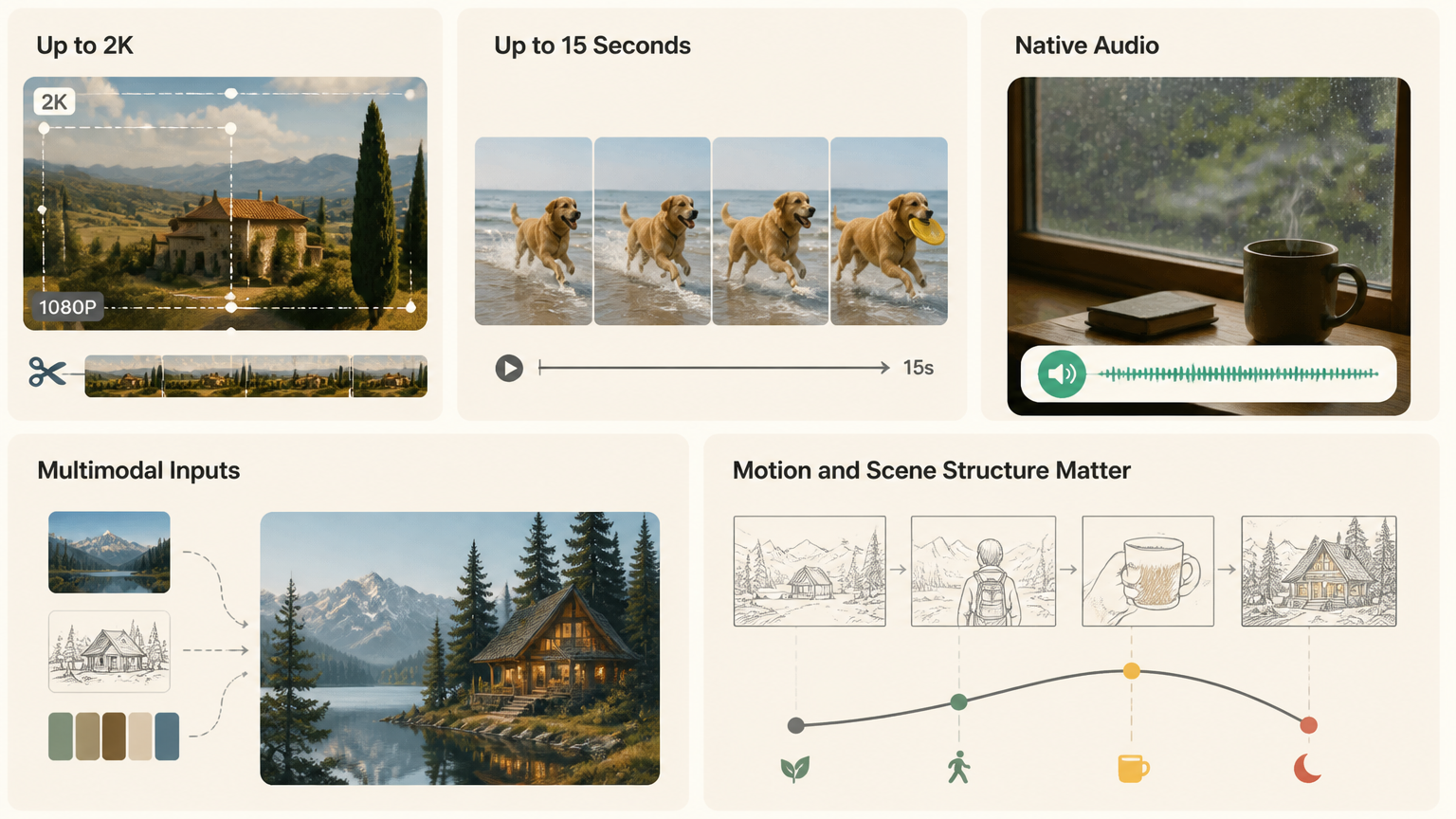
H3 supports video output at up to 2K resolution.
For practical creative work, higher resolution gives generated footage more room for adjustment during post-production. For example, when footage needs to be cropped, reframed, or adapted to different aspect ratios, higher-resolution output provides more flexibility.
This is particularly relevant as AI-generated video increasingly moves into commercial projects and client-facing production workflows.
Of course, resolution alone does not determine whether the final video has strong visual quality. Composition, character consistency, motion, lighting, and how closely the generated content matches the prompt all affect the final result.
Therefore, 2K is more accurately understood as providing a higher-specification source for subsequent creative work rather than as a standalone guarantee of final video quality.
Up to 15 Seconds Supports More Complete Continuous Actions
H3 supports video generation of up to 15 seconds.
A longer generation window gives a single scene more temporal space. Creators can describe multiple connected actions within one generation rather than separating every moment into an individual video clip.
For example, a character can enter a space, notice an object, react to it, and then move toward it. This type of continuous action allows a single video clip to carry more information.
For short-form storytelling, this means a 15-second video can communicate a more complete narrative beat, such as a discovery, interaction, emotional change, or environmental transformation.
However, longer videos also place greater demands on consistency. Characters, objects, clothing, and spatial relationships need to remain coherent throughout the sequence.
Therefore, the value of 15-second generation is not simply that the video is longer. It also depends on how consistently the model can maintain the scene throughout the generation.
Native Audio Brings Visual and Sound Creation into the Same Process
Native audio is one of the important differences between H3 and traditional AI video-generation workflows.
MiniMax confirms that H3 can generate videos with native stereo audio and incorporates audio into its multimodal generation process.
This means sound does not necessarily have to be treated entirely as a separate post-production step.
In a narrative scene, character movement can be accompanied by dialogue, environmental sounds, and other audio elements to create a more complete audiovisual sequence. For music visuals or atmosphere-driven content, sound can also become part of the scene's creative expression.
The value of this approach is not simply that it can reduce post-production work. More importantly, creators can consider visual and audio relationships from the generation stage.
However, whether native audio is suitable for direct use in a final commercial production still depends on the specific content. Dialogue accuracy, lip synchronization, voice consistency, emotional delivery, and the timing relationship between sound effects and visual actions all need to be evaluated in practical use.
Multimodal Inputs Make Reference Materials Part of the Creative Process
Another important change with H3 is its ability to understand text, images, video, and audio within a unified context.
This means reference materials can take on different creative roles rather than simply functioning as a basic image input.
For example:
· Text can describe the story, actions, and scene requirements.
· Images can provide character, product, environment, or visual-style references.
· Video can provide motion, action, or camera references.
· Audio can contribute to dialogue, sound, or the overall atmosphere.
This approach is closer to how real creative workflows operate.
In traditional video production, a director may simultaneously reference character designs, storyboards, action footage, music, and scene concepts. H3 attempts to allow these different types of information to contribute within the same generation context.
Therefore, the core change is not simply that H3 supports more input formats. It is that relationships between different media types can become part of the generation process.
Motion and Scene Structure Remain Important
Resolution and native audio attract considerable attention, but motion quality remains one of the fundamental factors determining the practical usefulness of AI video.
H3 supports not only direct video generation but also reference-based generation and editing, including multimodal video references and motion-transfer capabilities.
For dynamic scenes, camera movement is not merely a technical effect. It is an important part of visual storytelling.
Push-ins, tracking movements, changes in perspective, and variations in action timing can all influence the emotional tone and narrative structure of a scene.
By placing video, images, and other reference information within the same multimodal context, H3 allows creators to provide more explicit guidance about who the character is, how the character should move, how the camera should behave, and which visual relationships should remain consistent.
At the same time, dynamic content remains challenging to generate. In practical use, creators need to pay attention to whether character movements appear natural, whether camera movement matches the description, and whether characters and environments remain stable during complex actions.
MiniMax H3 vs. Hailuo 02
H3 and Hailuo 02 represent different stages in the development of MiniMax's video-generation products.
Feature | MiniMax H3 | Hailuo 02 |
Resolution | Up to 2K | Up to 1080p |
Generation Length | Up to 15 seconds | Primarily focused on shorter video clips |
Audio Generation | Native stereo audio | Not a primary native capability |
Creative Direction | Multimodal audiovisual scene generation | Visual video generation |
Core Characteristics | Multimodal understanding, video generation, audio, references, and editing | Visual generation, motion, and instruction understanding |
Positioning | General-purpose multimodal generation system | Video-generation model |
The two models should not be viewed simply as replacements for one another.
Hailuo 02 is more suitable for creators who have already built workflows around visual video generation, while H3 expands the range of information that can be processed by bringing text, images, video, and audio into a unified multimodal generation framework.
Therefore, both can have a place in creative workflows when the requirements are primarily focused on visual video generation. When a task requires multiple types of reference materials and combines sound with video generation and editing, H3's workflow is more aligned with those requirements.
Where H3 Fits into Creative Workflows
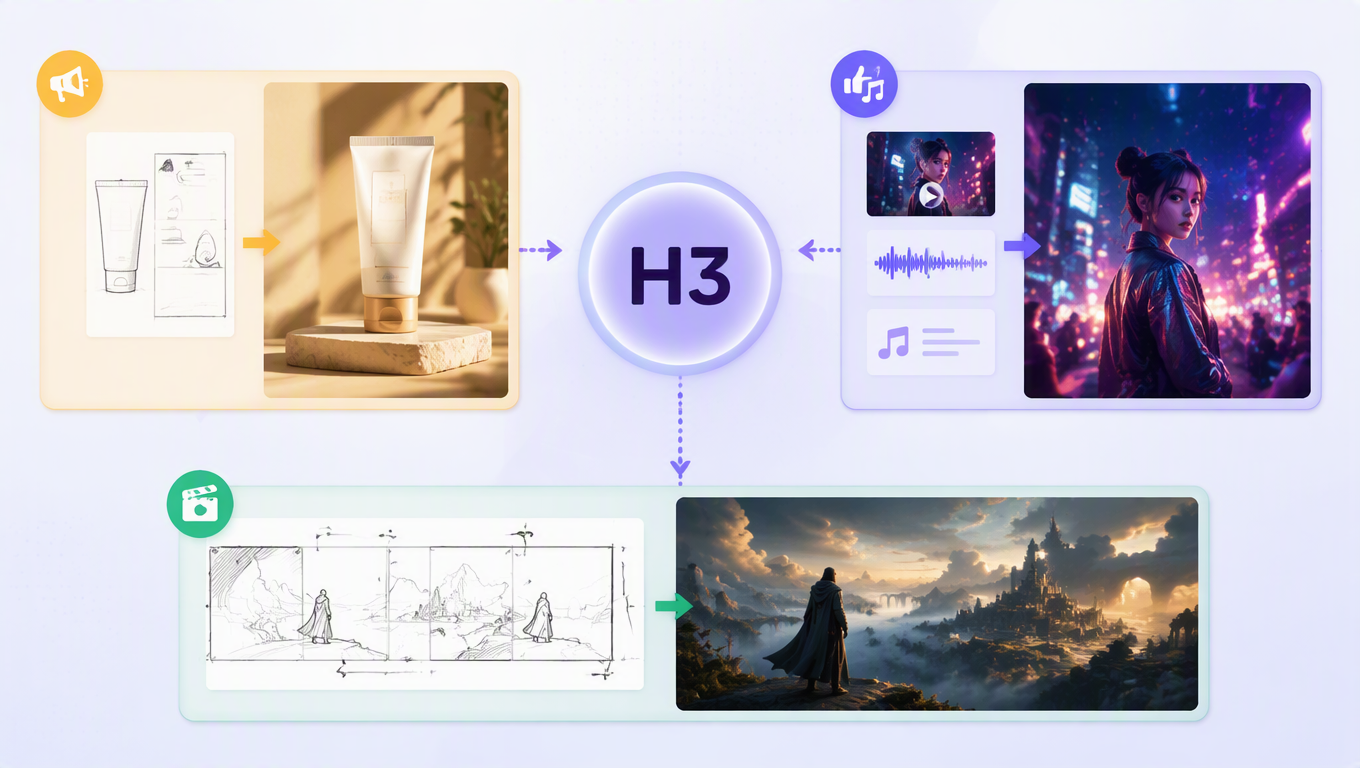
H3 is particularly suited to creative tasks where multiple production elements are closely connected.
Advertising and Product Content
H3 can be used to develop more complete advertising scenes rather than simply generating isolated product shots.
For example, a product advertising scene can combine product visual references, character movement, camera motion, environmental atmosphere, and sound.
This workflow can help creators validate a commercial concept more quickly before moving into full production.
For final advertising content, logos, packaging text, product specifications, and other brand-critical elements should still be added or corrected during post-production to ensure accuracy.
Social and Music Content
Short-form video often depends heavily on visual rhythm, movement, and immediate atmosphere.
H3's up-to-15-second generation capability and native audio can be used for fashion content, travel visuals, music concepts, promotional videos, and other short-form scenarios that emphasize continuous movement and atmosphere.
For music-driven visual content in particular, visual and audio elements can be considered together during generation rather than relying entirely on post-production to add sound after the video has been created.
This provides creators with a more direct way to explore different audiovisual directions.
Narrative Scenes and Pre-Visualization
For storytelling, H3 is better understood as a scene-building tool rather than a complete filmmaking system.
A video of up to 15 seconds can carry a meaningful narrative beat, such as a character discovering something, reacting to an event, interacting with another character, or responding to a change in the environment.
H3 can also be used for pre-visualization.
Directors, designers, advertising teams, and marketing teams can use generated scenes to test:
· Composition
· Camera movement
· Character actions
· Lighting
· Scene atmosphere
· Action timing
· Relationships between visual references
In this way, the value of AI video is not limited to directly producing content. It can also help creators validate ideas and make production decisions earlier in the creative process.
What Still Needs Attention in Practical Production
H3 already provides a relatively comprehensive multimodal generation framework, but there is still a gap between model capabilities and final production requirements.
Character and Scene Consistency
Longer video sequences place greater demands on character and scene consistency.
During actual generation, creators need to pay attention to whether facial features, clothing, hairstyles, objects, environments, and spatial relationships remain consistent from the beginning to the end of a video.
If a project requires multiple shots to form a continuous story, character definitions and reference materials become even more important.
Dialogue and Audio Synchronization
Native audio allows video and sound to be generated together, but the final result still needs to be evaluated according to the specific scene.
For dialogue-driven content, creators should check:
· Whether pronunciation is accurate
· Whether lip movements match the audio
· Whether the speaker's voice remains consistent
· Whether emotional delivery matches the scene
· Whether sound effects are synchronized with actions
Native audio can therefore reduce the number of separate audio-production steps, but it does not mean every generated soundtrack can automatically replace professional post-production.
Text and Brand Information
Precise text, logos, product packaging, user interfaces, and other brand-specific elements are particularly important in commercial content.
Even when the model can process these visual elements, final commercial projects still require careful inspection.
When pixel-level accuracy is required for text or brand information, final processing is better handled during post-production.
Fine-Grained Control
Professional production requires more than a good-looking result. It also requires repeatability.
In practical workflows, creators therefore need to consider how much control the model provides over camera movement, aspect ratio, reference materials, audio behavior, and other generation parameters.
The clearer and more controllable these settings are, the easier it becomes to turn AI video from a one-time creative experiment into a repeatable production workflow.
Generation Stability
AI video creation rarely ends with a single generation.
A complete project often requires multiple generations, selections, and adjustments.
Therefore, production efficiency depends not only on the quality of an individual video but also on whether the model can maintain relatively stable results across different prompts, reference materials, and scenes.
This is another important factor to observe when evaluating H3 in real commercial workflows.
From Clip Generation to Scene Generation
From the perspective of the broader development of AI video, H3 can be understood as part of the progression toward more complete scene generation.
Early AI video models primarily focused on making elements in static images move convincingly.
Later generations began addressing continuous actions, character identity, and physical behavior.
Longer video generation provided creators with more temporal space, allowing a single clip to carry a more complete scene or narrative beat.
The addition of native audio expands the scope of AI video generation even further.
The question is therefore no longer simply:
Can AI generate a visually compelling video clip?
Instead, it becomes:
Can AI generate a coherent audiovisual scene in which visual actions, camera movement, timing, and sound work together?
H3's design direction is centered around this shift.
It is not intended to eliminate every traditional production step. Instead, it reduces some of the disconnected processes between an initial creative idea and a usable scene.
The Real Significance of MiniMax H3
The importance of MiniMax H3 does not come from any single specification.
Up to 2K video output provides a higher-specification source for post-production. Up to 15 seconds of generation provides more room for continuous actions and narrative progression. Native stereo audio brings sound into the video-generation process. Meanwhile, unified understanding of text, images, video, and audio changes how creators interact with the generation model.
At the same time, H3 supports multimodal references and video editing, allowing creators to use different types of materials to guide the generation process rather than relying entirely on a single text prompt.
This makes H3 closer to a comprehensive multimodal creative tool.
From a workflow perspective, creators can begin with an idea, add character images, scene references, motion videos, or audio materials, and then generate a more complete audiovisual result through a unified process.
This approach can reduce the need to repeatedly switch between different tools and transfer materials between separate production stages.
Final Assessment
MiniMax H3 represents the direction of AI video generation moving from simple video-clip creation toward multimodal audiovisual scene generation.
It now officially provides video generation at up to 2K resolution and up to 15 seconds in length, with native stereo audio, while also supporting unified processing of text, images, video, and audio information.
Compared with workflows that focus primarily on text-to-video generation, H3 places greater emphasis on relationships between different types of media.
Creators can use text to describe an idea, images to provide character or visual references, video to provide action or camera information, and audio to build the sound environment. The model can then process these elements within a unified multimodal context.
This workflow is particularly relevant to advertising, social content, music visuals, short-form storytelling, and pre-visualization.
Of course, H3 does not mean that traditional post-production is no longer necessary. Brand text, logos, product details, dialogue accuracy, final editing, and other elements that require precise control still need to be reviewed and processed during post-production.
H3 is therefore better understood as a tool that can compress some of the production steps between a creative concept and a finished scene.
Its core value is not simply that it can generate longer videos. Instead, it enables visuals, sound, reference materials, and scene editing to work together within a more unified generation process.
From this perspective, MiniMax H3 is not simply another AI video-generation model. It represents a step toward scene-level multimodal video creation, where AI can move beyond generating isolated clips and become a more integrated part of developing complete creative sequences.
Frequently Asked Questions
What is MiniMax H3?
MiniMax H3 is a general-purpose multimodal generation model developed by MiniMax. It can understand text, images, video, and audio within a unified context and generate videos with native stereo audio. According to MiniMax's official information, H3 supports video generation at up to 2K resolution and up to 15 seconds in length.
What are the main features of MiniMax H3?
H3's core capabilities include video generation at up to 2K resolution, generation lengths of up to 15 seconds, native stereo audio, multimodal inputs, and the ability to generate and edit content using image, video, and audio references.
How long can MiniMax H3 generate video?
According to MiniMax's official information, H3 can generate videos of up to 15 seconds in a single generation.
Can MiniMax H3 generate audio?
Yes. Native stereo audio is one of H3's core capabilities. The model can generate audio content alongside the video as part of its multimodal generation process.
What inputs does MiniMax H3 support?
H3 supports multiple types of input, including text, images, video, and audio, and can understand these different types of information within a unified multimodal context.
Does MiniMax H3 support video editing?
Yes. H3's multimodal capabilities are not limited to video generation. They also support reference-based video generation and editing using materials such as video, images, and audio.
Does MiniMax H3 support motion transfer?
Yes. Motion transfer from video to video is part of H3's multimodal video capabilities, allowing motion information from a reference video to contribute to the generation of new video content.
What is MiniMax H3 best used for?
H3 is particularly suitable for advertising, social media content, music visuals, short-form storytelling, creative visualization, and pre-visualization. Its multimodal workflow is especially useful for creative tasks that require text, image, video, and audio references to work together.
Can MiniMax H3 completely replace traditional video production?
Not simply.
H3 can reduce some of the work involved in material generation, scene exploration, and pre-production, but commercial videos still typically require human review and post-production for brand text, logos, product information, precise dialogue, final editing, and other elements that require strict control.
What is the core change introduced by MiniMax H3?
The most important change is not a single video-generation specification. It is the integration of text, images, video, audio, video generation, and editing into a more unified multimodal workflow.
This allows AI video generation to move beyond isolated clip creation and toward more complete audiovisual scene creation.